
CDR Framework
CDR (Compress, Divide, Renew) is the main theoretical framework behind Synix. It argues that bounded-resource systems operating over long horizons face three recurring pressures:
- they must compress
- they must separate information with different timescales
- they must revisit stale compressed representations
Status: Formal paper in preparation. The claims below should be read as theoretical arguments, not established results.
Theorem 1: Irreversible Compression
Section titled “Theorem 1: Irreversible Compression”A system with finite memory receiving continuous input must eventually discard something. The discarded information is permanently lost — no internal reorganization recovers it.
Formal statement. Let P be a bounded-state processor with capacity C bits receiving observations from a source with entropy rate h > 0. There exists a threshold T* ≤ C/h beyond which unanswerable queries exist, grow monotonically, and are unrecoverable by internal processing.
Proof sketch. Capacity bound C and positive entropy rate h guarantee incoming information exceeds storage after T* = C/h steps (pigeonhole). The Data Processing Inequality guarantees that no function of retained state can increase mutual information with discarded observations.
Distributed systems parallel. Write-ahead log truncation: once the log is truncated past a checkpoint, pre-checkpoint operations are unrecoverable.
Design implication. Every memory region will lose information. The architecture tries to control what is lost and when, not prevent loss.
Theorem 2: Temporal Partitioning
Section titled “Theorem 2: Temporal Partitioning”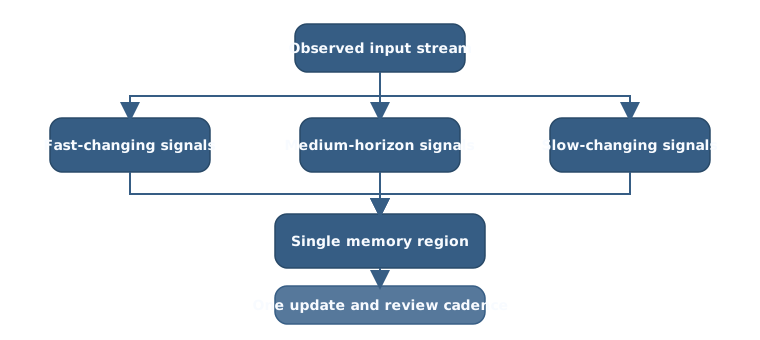
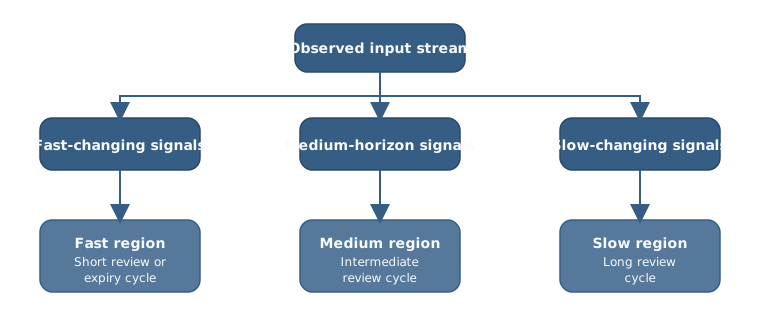
A system tracking both fast-changing and slow-changing phenomena likely benefits from partitioning state by timescale. A single update rate either misses fast changes or wastes capacity re-encoding slow features that have not changed.
Formal statement. For a source with K timescale components, a matched partition outperforms a homogeneous encoder in worst-case distortion under the assumptions of the model.
Proof sketch. A homogeneous encoder at rate τ incurs aliasing on components with timescale < τ and wastes capacity on components with timescale >> τ. A matched partition eliminates both.
Distributed systems parallel. Sharding by access pattern — similar to separating OLTP from OLAP workloads or hot from cold storage.
Design implication. Different memory regions operate at different timescales: hours, days-to-weeks, months-to-quarters, permanent, archival.
Theorem 3: Finite Optimal Lifespan
Section titled “Theorem 3: Finite Optimal Lifespan”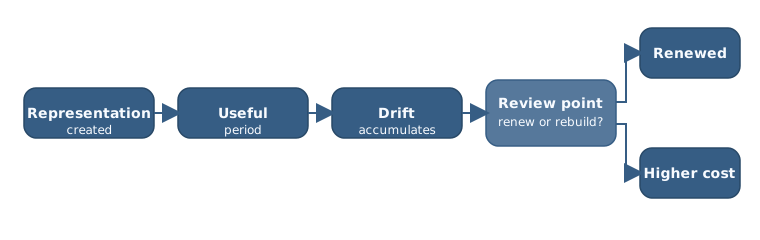
Even a well-partitioned system degrades over time through distributional drift and error accumulation. One proposed consequence is that rebuilding from scratch eventually becomes cheaper than continuing to patch a degraded representation.
Formal statement. If degradation D(t) is unbounded, the long-run average cost J(τ) = [S + ∫₀^τ D(t)dt] / τ has a finite minimizer where D(τ*) = J(τ*).
Proof sketch. J(τ) → ∞ as τ → 0 (renewal cost dominates) and J(τ) → ∞ as τ → ∞ (degradation dominates). Continuity guarantees an interior minimum. This is a standard result in renewal-reward theory applied to information-processing degradation.
Distributed systems parallel. Cache invalidation with a tuned TTL. Also parallels rolling restarts of long-running services.
Why it matters to Synix. This is the part of the framework that most directly motivates explicit review, decay, and renewal mechanisms in the architecture.
Theorem 4: Recursive Necessity
Section titled “Theorem 4: Recursive Necessity”The three properties may recur at multiple levels of a hierarchy. Each partition produces compressed output that becomes input for the next level. Under the model’s assumptions, similar constraints appear again at the next level.
Distributed systems parallel. Hierarchical caching (L1/L2/L3), where each level has its own eviction and refresh policy.
Design implication. In Synixolis, the framework is used at three scales: memory within a node, conventions and routing policies, and multi-node coordination.
What CDR does not do
Section titled “What CDR does not do”CDR is intended to identify design pressures, not fully specify an architecture. The gap between “renewal matters” and “here is how to implement it well” is what the memory architecture and Synixolis protocol are trying to close.
The formal proofs are in the CDR paper (in preparation). Until that work is published and reviewed, the claims here should be read as theoretical arguments, not established results.