
Memory Architecture
The memory architecture is the proposed next step after the batch build system: a continuously maintained memory store with explicit lifecycle management, provenance, and governance.
Status: In design and early implementation.
Motivation
Section titled “Motivation”The build system works for cold data but is a poor fit for:
- real-time state changes
- concurrent writers
- continual review and decay
- governance over who can change shared state
The memory architecture is the proposed answer: keep the object-store and provenance ideas, replace periodic rebuilds with explicit write, review, and governance paths.
Design
Section titled “Design”The architecture has four layers:
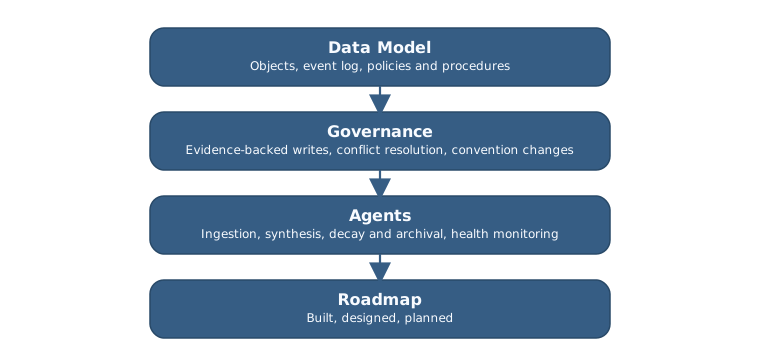
Data Model — Immutable content-addressed objects, an append-only event log, policies stored as documents, and procedures stored as text. Infrastructure provides content-addressing, atomic writes, full-text search, and the event log.
Governance — Evidence-based writes, conflict resolution with audit trails, hypothesis tracking, and controlled convention changes. The goal is to prevent concurrent agents from degrading shared state.
Agents — Workers with defined roles and triggers. A minimal deployment has ingestion, synthesis, decay/archival, conflict resolution, and health-monitoring roles.
Roadmap — What is built, what is designed, and what is planned.
Current reality
Section titled “Current reality”This architecture is not fully implemented.
- The object store and search index come from the build system.
- The event log, policy engine, and governance mechanisms are still design work.
- The multi-agent parts should be read as proposed architecture, not observed system behavior.
What carries forward from the build system
Section titled “What carries forward from the build system”| Component | Survives | Changes |
|---|---|---|
| Object store | Content-addressing, atomic writes | Add author, region, confidence fields |
| Search | FTS5 keyword indexer | Becomes a materialized view of the event log |
| Transforms | Prompt templates, synthesis logic | Become procedure documents, not Python classes |
| Server | MCP endpoint, REST API | Add event log and policy evaluation |